Private Equity Primer
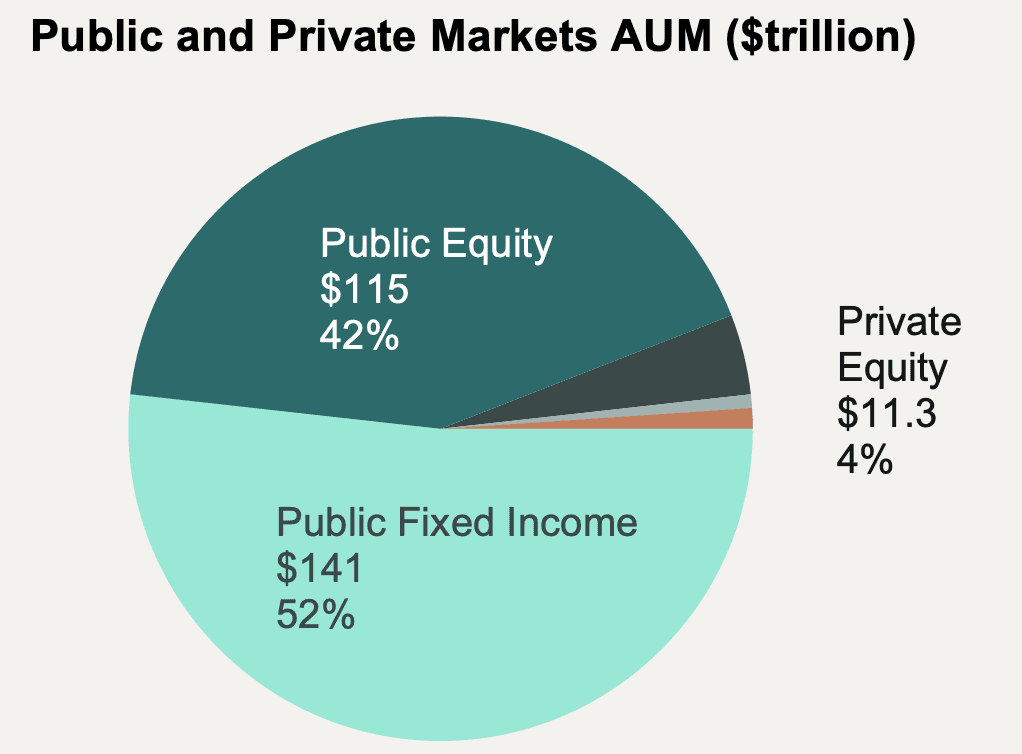
Private equity generally invests in private companies that are not listed on a stock exchange. Private equity makes up a small share of global investable assets, yet it is a growing segment that provides access to a far larger universe of companies than the public markets.
Fund Structure: Allocations can be structured as closed-end limited partnerships (with lifespans of 7–10 years) or as evergreen, open-end structures. The investor, or limited partner (LP), makes a commitment to a fund that the investment manager, or general partner (GP), invests in a set of portfolio companies (or partnership interests in the case of fund-of-funds and secondaries funds).
Why Invest in Private Equity?
Returns: Over a full market cycle (10+ years), private equity has historically outperformed public equity by ~2–3% annually (LSEG/Cambridge Private Equity Database). However, it is important to note that distributions and returns are never guaranteed and that these investments carry a high degree of risk, including the risk of total loss of capital. Past performance is no guarantee of future results or success.
This potential return premium may compensate investors for the illiquidity of private equity’s closed-end fund structure and complexity of transactions. Over that time, GPs aim to generate returns in their portfolio companies through operational and financial improvements, which may include the use of leverage.
Diversification: Private equity may provide a differentiated return stream to a portfolio of publicly traded securities by giving access to private, and often smaller cap, companies.
Challenges
Illiquidity: In closed-end vehicles, capital is typically locked up for 10–15 years (with the potential for periodic distributions during that timeframe). Investors may be able to sell their partnership interests in the secondary market, but these assets are typically sold at a discount to net asset value (NAV).
Fees: These are typically significantly higher than public markets strategies, with management fees of 1.0%–2.0% on committed capital and carried interest (performance or incentive fee) of 20% or more of profits.
Implementation Risk: There is a wide variation in returns among private equity funds, which makes manager selection especially critical. Mistakes are long-lasting and holdings cannot easily be liquidated or rebalanced.
Program Complexity: Private equity has significant administrative complexity, as diversified portfolios involve numerous funds that require legal, operational, and accounting oversight. Programs require annual commitment pacing to ensure investors maintain their private equity exposure.
Benchmarking: Private equity lacks a perfect benchmark, as no passive, investable index exists. Investors may use a peer group of comparable funds such as those published by Cambridge or MSCI Burgiss and/or a public markets index plus a premium for illiquidity (e.g., Russell 3000 + 2%).
Investment Timeline
Closed End Funds
Investment Period: During the first 4–6 years of a closed-end fund’s life, the GP typically draws down LP commitments and may invest in ~10–30+ portfolio companies.
Harvest Period: GPs may seek to add value to those companies through operational and financial improvements. After a holding period of 3–6 years, on average, the GP may exit through a sale or IPO.
Liquidation Period: Typically in the final 2–3 years of the fund’s term, the last remaining assets are sold and the fund liquidates.
The net asset value (NAV) reflects this cycle—rising as capital is called, then declining as distributions are made. As a result, GPs typically launch new funds every 3–4 years, and LPs may continually invest in new partnerships as older ones expire in order to maintain their private equity exposure.
Evergreen & Open-End Funds
In an evergreen, open-end vehicle, an investor’s capital is invested immediately into an existing portfolio of underlying portfolio companies, secondary interests, and fund interests. Proceeds are typically reinvested into the portfolio (rather than distributed back to investors), with periodic liquidity available to investors upon request.

Strategy Types
Private equity consists of several strategy types, including but not limited to:
Buyout: Investments in mature businesses, usually taking majority control (>50%) and actively managing the company through exit
Venture Capital:Minority investments in earlier-stage companies with significant growth potential, often in technology or health care
Growth Equity: Investments in established but growing companies, through either majority control or significant minority stakes, focused on scaling and profitability—sits in between buyouts and venture capital
Distressed/Restructuring: Investments in companies facing financial or operational challenges, often through a mix of debt and equity
Secondaries: The purchase of existing interests in funds or portfolio companies, typically at a discount
Co-Investments: Direct investments into specific portfolio companies alongside a GP, typically on a no fee and no carried interest basis
Fund-of-Funds: Fund that invests in a portfolio of private equity partnerships, which may include secondaries and co-investments
Return Metrics
Because the GP has discretion over the timing of cash flows, private equity returns generally use the internal rate of return (IRR) and total value to paid-in capital (TVPI) calculations, rather than the time-weighted returns (TWRs) associated with public equity.
TVPI: Total Value to Paid-In Capital. A more simplistic ratio that measures the value of a private equity fund (both realized and unrealized) relative to the amount contributed (e.g., a 1.5x TVPI means $1 invested is worth $1.50). Because it does not account for the time value of money, the TVPI is best considered alongside the IRR.
DPI: Distributions to Paid-In Capital. The portion of TVPI that has been realized as cash is returned to investors.
IRR: Internal Rate of Return. The implied discount rate that equates the present value of cash outflows (Paid-In Capital) with the present value of cash inflows (Distributions + NAV). Unlike the TVPI, this calculation incorporates the time value of money.