Core Real Estate Investing Primer
Core real estate equity is a private real estate strategy typically focused on generating stable income and preserving capital through investment in potentially high-quality, stabilized commercial real estate. These assets are typically located in major economic markets with durable tenant demand and strong operating fundamentals. As the most conservative segment of equity real estate, we have often observed Core strategies widely used as a long-term portfolio anchor and often represent a significant allocation within institutional real assets portfolios. Core real estate may provide diversification benefits relative to traditional stocks and bonds while offering exposure to tangible assets supported by potential contractual rental income. However, core real estate investments are generally illiquid, involve significant fees and expenses, and are subject to risks including tenant vacancies, property value declines, and interest rate sensitivity. Past performance is not indicative of future results.
Strategy Overview
Core real estate investments consist of equity ownership typically in stabilized, income-producing commercial properties across major property sectors, including office, industrial, multi-family, retail, and, increasingly, select alternative property types such as self-storage, life sciences, and medical offices. Properties are typically well leased at acquisition, generally targeting occupancy rates above 85%, and may feature high-quality construction, competitive design, and institutional-grade tenants.
Compared to other private real estate strategies, core real estate investments are distinguished by potentially minimal leasing, development, or repositioning risk, with operating performance largely driven by existing tenants and in-place cash flows. Financial leverage is typically modest, generally less than 35% loan-to-value, which may help reduce volatility and downside risk during periods of market stress.
Returns in core real estate are primarily income-oriented. Historically, a significant majority of total returns have been generated from net operating income rather than appreciation. As a result, core real estate tends to exhibit lower return dispersion across managers relative to higher-risk strategies, though manager skill remains important in asset selection, leasing execution, and portfolio construction (NCREIF, Callan LLC).
Within the broader private real estate universe, strategies are commonly differentiated by their risk profiles, use of leverage, mix of property sector exposure, and return drivers (i.e., income vs. capital appreciation). For example, Core-plus strategies work to introduce a moderate tilt toward enhanced returns by selectively incorporating leasing, capital improvements, or development exposure and employing moderately higher leverage, resulting in a greater contribution from appreciation alongside stable income. Value-add strategies further increase risk by targeting assets with meaningful operational, leasing, or capital execution requirements, with returns driven more evenly between income and appreciation. Opportunistic strategies, meanwhile, will often involve development, repositioning, or distressed assets, higher leverage, and limited in-place income, with total returns primarily dependent on capital appreciation.
Core Real Estate Structures and Risk Profile
Core real estate investments are typically accessed through open-end, diversified funds or separate accounts. Open-ended core funds allow investors to make periodic capital commitments and redemption requests, subject to fund liquidity and capacity constraints. These vehicles are designed to provide long-term exposure to stabilized assets and typically hold properties indefinitely rather than targeting a predefined exit date.
Valuations of core real estate assets are generally based on third-party appraisals conducted at least annually, supplemented by internal valuations performed more frequently. This appraisal-based valuation framework contributes to lower reported volatility compared to publicly traded real estate securities, but may understate actual price risk because of lagged pricing adjustments during periods of rapid market change. Investors should not interpret lower reported volatility as equivalent to lower investment risk.
From a risk perspective, core real estate is exposed to property-level risks such as tenant vacancies, operating expense growth, and localized market conditions, as well as macroeconomic factors including interest rate movements and capital markets liquidity. The combination of stabilized income and conservative leverage has historically helped mitigate downside risk relative to higher-leverage real estate strategies, though losses of principal remain possible.
Entry and Exit Queues
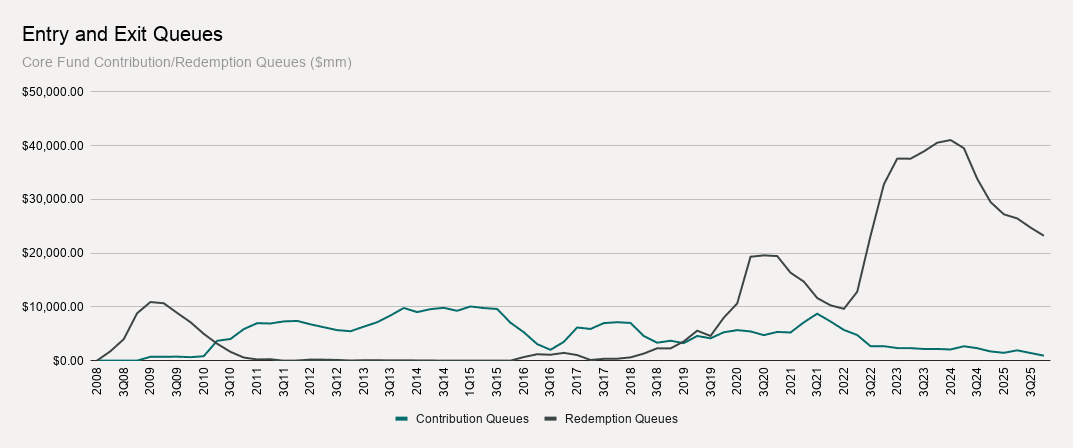
Core real estate investments, particularly those accessed through open-ended funds, may be subject to entry and exit queues that influence investor capital flows and liquidity. These vehicles typically allow investors to subscribe or redeem capital on a periodic basis, most commonly quarterly, but transactions are often limited by fund-level cash management constraints. During periods of strong investor demand, new capital commitments may be delayed through entry queues, as managers seek to deploy capital prudently without diluting existing investors or acquiring assets at unfavorable pricing. Conversely, during periods of market stress or rising redemption activity, exit queues may form when funds limit withdrawals to preserve portfolio stability and avoid forced asset sales. As illustrated in Exhibit 1, redemption queues reached approximately $41 billion during the 2022 cycle, and investors in some funds experienced multi-year delays in accessing capital. As a result, core real estate is generally considered less liquid than publicly traded securities, and investors should maintain a long-term investment horizon and plan portfolio liquidity accordingly.
Exhibit 1: Core Real Estate Entry and Exit Queues
Source: Callan Research, September 30, 2025
NCREIF Open-End Diversified Core Equity (ODCE) Index
The NCREIF Open-End Diversified Core Equity (ODCE) Index is the primary institutional benchmark for U.S. core real estate and is widely used to evaluate the performance of open-ended core real estate funds. The ODCE represents a universe of diversified, institutionally owned portfolios invested in stabilized, income-producing properties with moderate leverage. Fund portfolios included in the ODCE are typically diversified across property sectors and geographic regions and are appraised quarterly, resulting in return profiles that emphasize income stability and reported lower volatility relative to higher-risk real estate strategies. As a result, ODCE performance is often used by investors to assess the risk-return characteristics of core real estate allocations and to evaluate manager performance relative to peers with similar investment mandates.
Characteristics Commonly Considered by Investors
Investors evaluating core real estate typically consider the following characteristics:
Income profile. Core real estate returns have historically been driven primarily by rental income from in-place leases (NCREIF). While rental cash flows from stabilized properties have historically exhibited lower volatility relative to some other real asset strategies, distributions are not guaranteed and may decline due to tenant defaults, vacancies, or adverse market conditions.
Correlation to other asset classes. Private real estate returns have historically exhibited low correlation with traditional equities and fixed income, particularly over longer measurement periods (Callan). This low correlation is partly attributable to appraisal-based pricing and may not persist in all market environments. Diversification does not eliminate the risk of loss.
Inflation sensitivity. Certain lease structures, including contractual rent escalations and periodic lease rollovers, may allow property income to adjust over time in response to inflationary conditions. The degree of inflation sensitivity varies by property type, lease term, and market conditions, and there is no assurance that rental income will keep pace with inflation.
Core real estate is commonly categorized within an investor’s real assets or private real estate allocation. Institutional investors may combine core strategies with higher-risk approaches such as value-add or opportunistic real estate, depending on their investment objectives and risk tolerance.
Fees and Expenses
Core real estate investments typically involve management fees, which may include both asset management and property management fees, as well as fund-level operating expenses. Some vehicles also charge incentive or performance-based fees. These costs reduce net returns to investors and should be considered when evaluating the potential benefits of a core real estate allocation. Fee structures vary by vehicle and manager, and investors should review all applicable offering documents for complete fee disclosure.
Important Disclosures
This material is provided for educational and informational purposes only and does not constitute an offer to sell or a solicitation of an offer to buy any security. Past performance is not indicative of future results. All investments involve risk, including the potential loss of principal. Core real estate investments are illiquid, involve substantial fees and expenses, and are subject to risks including but not limited to tenant vacancies, property value declines, interest rate changes, and restrictions on redemptions. Historical data cited herein is sourced from Callan LLC and NCREIF and reflects specific time periods that may not be representative of future conditions. Any comparisons to publicly traded securities are for illustrative purposes only and do not account for material differences in liquidity, fees, transparency, valuation methodology, or minimum investment requirements.
This material was prepared by Callan LLC at the request of and with compensation from CrowdStreet, Inc. Callan LLC is an independent institutional investment consulting firm and is not affiliated with Crowd Street