How your financial designation can unlock access to more investment opportunities
Your eligibility for certain private market investments depends on how you're classified under federal securities law. Three designations, in ascending order, each open the door to additional types of offerings: accredited investor, qualified client, and qualified purchaser. This article explains what each one means and what it gives you access to.
Most private markets offerings rely on exemptions which allow them to avoid enhanced disclosure and reporting requirements mandated by the Securities and Exchange Commission (SEC). Many of these exemptions restrict general solicitation and limit sales to certain designated investors.^1^
Each designation provides access to additional types of offerings.
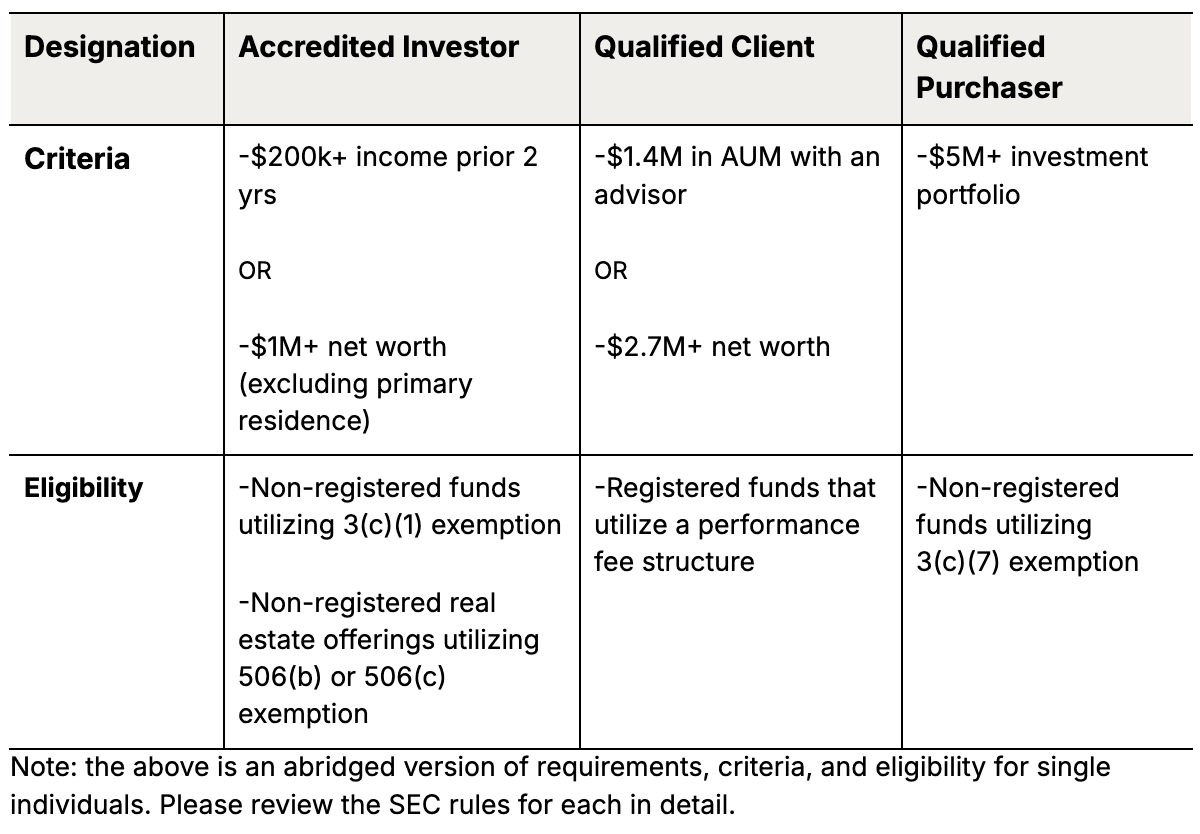
The first designation is Accredited Investor.
Criteria
An individual must either have:gross income of more than $200,000 the prior two years ($300,000 with a spouse) and expect to maintain that salary, OR a net worth of more than $1M (excluding your primary residence)2
An entity must either have:gross assets greater than $5 million and be directed by a 'sophisticated person' with sufficient financial and business knowledge to make prudent decisions, ORBe owned entirely by accredited individuals
What it gives you access to
Accredited investors will typically have access to the following private markets offerings:
Smaller non-registered funds that utilize performance fee structures. By relying on the 3(c)(1) exemption, they are able to avoid registration and utilize performance fee structure, but they are capped at 100 beneficial owners.
Single-asset real estate offerings. These offerings are typically viewed as investments in physical property and not securities or investment companies. For this reason, they may avoid registration, utilize performance fee structures, and admit more than 100 investors when they rely on the 506(c) or 506(b) exemption.
The second designation is Qualified Client.
Criteria
An individual must either have:$1.4 million in assets under management (AUM) with the advisor immediately after entering into an investment advisory contract with the advisor; ORa net worth of more than $2.7M, either by themselves or jointly with their spouse3
An entity must have $1.4M in AUM with the advisor immediately after entering into an investment advisory contract with the advisor
What it gives you access to
Qualified Clients will typically have access to these additional private markets offerings:
Registered fund offerings that utilize a performance fee structure. By registering they may permit more than 100 investors, but the use of performance fee structure means they can only admit qualified clients
The third designation is Qualified Purchaser.
Criteria
An individual must have an investment portfolio of more than $5M
An entity must have an investment portfolio of more $25M4
What it gives you access to
Qualified purchasers will typically have access to these additional private markets offerings:
Larger non-registered funds that utilize performance fee structures. Relying on the 3(c)(7) exemption, they are able to avoid registration and utilize performance fee structure and are able to accept up to 1,999 qualified purchasers.
Potential Benefits and Trade-Offs
Avoiding registration can reduce the administrative costs borne by the investment, which could improve net returns. It also allows for more flexibility and a quicker set up and fundraise period, which can potentially provide the sponsor a competitive advantage. The same lighter framework also removes some investor protections and reporting requirements.
Permitting a larger number of investors can increase the fund’s AUM, which means more capital could be put to work and could allow larger scale, which some funds use to support more diversification, absorption of negative results across the portfolio, and reduction of expense ratio. However, larger scale does not by itself reduce investment risk.
The use of performance fees can incentivize investment managers and align their interests with the investors, and the manager is motivated to seek risk-adjusted results. Alternatively, they can also encourage greater risk-taking and increase what you pay when the strategy performs, because the manager typically shares in gains but not in losses. Views on performance-fee alignment vary; the sources listed below present the favorable case.
Key Risks
These potential benefits are of course not guaranteed, and underperformance is still a very real risk, including a full loss of capital. Additionally, avoidance of registration comes with its own risk as well, as it removes some investor protections and reporting requirements. These offerings are also generally illiquid, as there is typically no public secondary market and transfers are restricted; therefore, investors should be prepared to hold for a long and potentially indefinite period.
In Summary
Eligibility does not mean the offering is a fit, but rather it simply increases the number of offerings made available to you. And availability of an offering through Crowd Street is not a recommendation to invest in it. As with any investment, investors should thoroughly consider each offering in depth before making a decision.